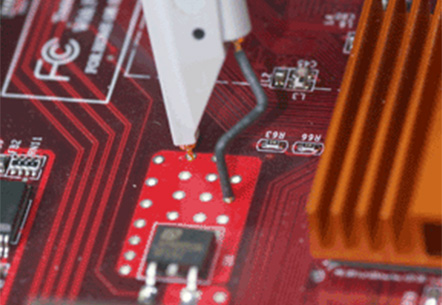
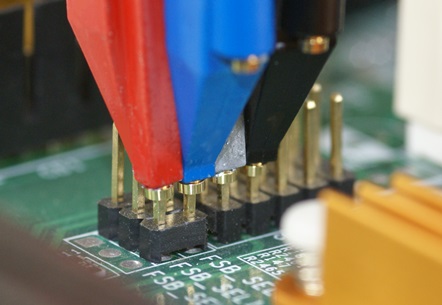
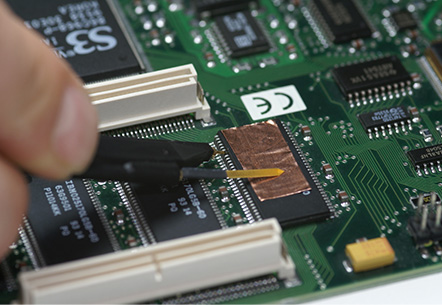
The active probes of the TETRIS® series offer a wide dynamic measurement range of ±8V and up to 2.5GHz bandwidth. With a very high input resistance of 1 MΩ and a low input capacitance of 0.9 pF, TETRIS® series probes are ideal for a wide range of low and high frequency measurements. Individual contacting options, including the unique in-line probing system for multi-contacting adjacent pin connectors in 2.54mm pitch, and the universal BNC connector for measurement instruments with 50Ω input make the active probe TETRIS® series universally applicable in every lab.
All TETRIS® probes are inclusive one power supply PS-01 with adapters for EU, UK, US, AUS for 100V to 220V mains.
The cable length of 1.3m can be customized on request.
Key features:
1. Bandwidth up to 2.5GHz: addresses high-frequency signal challenges
The maximum bandwidth of the PMK Tetris series active probe is up to 2.5GHz, a feature that enables it to perform well in high-frequency signal detection. Whether for high-speed data transmission in communication systems or signal analysis in high-speed electronic equipment, the probe provides a stable response. Its wide bandwidth not only ensures measurement accuracy but also effectively mitigates the influence of high-frequency interference on measurement results.
2. Input impedance greater than 1MΩ: suitable for high-impedance loads
The input impedance of the PMK Tetris series active probe is greater than 1MΩ, a feature that enables it to adapt to high-impedance load environments. In some industrial equipment or electronic circuits, high-impedance loads are a common configuration, and the probe's high input impedance design effectively reduces charge discharge and reflection, ensuring stable signal transmission. This design enables the probe to perform well in measurements with high-impedance loads.
3. Input capacitance of 0.9pF: optimizes signal transmission
The input capacitance of the probe directly affects signal transmission quality. The input capacitance of the PMK Tetris series active probe is 0.9pF; after precise tuning, it can achieve good impedance matching with cables of different lengths and probes, thereby reducing signal distortion and interference. This design allows the probe to maintain high-precision measurement even in long-cable or complex environments.
4. Dynamic measurement range of ±8V: suitable for voltage measurement
The dynamic measurement range of the PMK Tetris series active probe is ±8V, and this specification enables it to perform well in voltage measurement. Whether for precise measurement in low-voltage environments or complex signal analysis at medium voltages, the probe provides reliable measurement results. The breadth of its dynamic range makes it suitable for various voltage measurement scenarios.
5. Maximum input voltage up to 20V
In live measurements, safety and reliability are key. The maximum input voltage of the PMK Tetris series active probe is up to 20V, meeting measurement requirements in low-voltage high-speed environments. Its 20V voltage withstand capability not only ensures measurement safety but also avoids measurement errors caused by voltage fluctuations or transient changes.
6. Equipped with multiple probe accessories to adapt to various measurement environments
To meet the needs of different scenarios, the PMK Tetris series active probe provides multiple accessories, and users can select and combine them according to actual needs. For example, cables of different lengths, adapters, connectors, etc., can meet the requirements for long-distance measurement, measurement at different voltage levels, and installation in complex environments. This flexibility enables the probe to perform well in various fields such as power systems, industrial equipment, and electronic equipment.
7. High dynamic performance: suitable for rapidly changing signals
The PMK Tetris series active probe has excellent dynamic performance and can respond quickly to signal changes. Its fast response time and low-power design enable it to perform well in dynamic measurement, making it suitable for measurement of rapidly changing signal sources such as high-frequency pulses or transient signals.
It is the same type of probe as Sonic, but its bandwidth is lower than that of Sonic, its input impedance is smaller, and its input capacitance is larger; it can be regarded as a lower-tier alternative to Sonic.