


 Tektronix
Categories
Probemart.com | Probes, current sensors & calibration sources for pulsed-power testing
 Bookmark

 Product Categories
Tektronix
Categories

The P7600 Series TriMode probes and MSO/DPO70000DX and DPO/DSA70000D Series oscilloscopes are designed to provide extremely low system noise levels. This high sensitivity is very important for accurate measurements on low-amplitude signals.
Full 33 GHz bandwidth to the probe tip (P7633)
Extremely low probe and oscilloscope system noise
TriMode™ probe - three measurements with one setup and no probe tip connection adjustment required
Differential
Single-ended
Common mode
Remote head design connection
Uses P7500 Series TriMode solder-in probe tips
2.92mm
SMP
Allows the probe amplifier to be placed close to the circuit under test
Coaxial adapter
P7500 probe tip adapter
The probe automatically detects the tip and applies a DSP correction filter
Probe-specific S-parameters
Creates a unique DSP filter from data stored in the probe
TekConnect® interface - TekConnect oscilloscope/probe control and use
Direct control from the probe compensation box or oscilloscope menu
Including but not limited to:
MIPI M-PHY, PCI Express, Serial ATA, Serial SCSI, Fibre Channel, and HDMI
TriMode probing improves efficiency by enabling differential, single-ended, and common-mode measurements with a single probe setup. Connecting a probe to the device under test can be quite time-consuming, especially when the probe requires multiple setups to complete all required measurements. TriMode probing enables three different types of measurements with only one device setup, shortening setup time and thereby improving efficiency. It is easy to switch among differential mode [A-B], single-ended mode [A-Gnd, B-Gnd], and common-mode [((A+B)/2)-Gnd] with a single button press.
Changing the probe input mode requires only a single button press
As high-speed serial data standards increase in speed and signal swings shrink, high-bandwidth probes with both low-noise and high-sensitivity characteristics are increasingly important for accurate measurements.
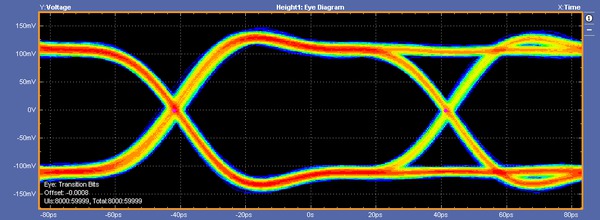
12 Gb/s 200 mVppSignal measured with the P7633 and P76CA-292C coaxial adapter
The MSO/DPO70000DX and DPO70000SX series oscilloscopes and P7600 series TriMode probes are designed to provide extremely low system noise levels. When used with P76CA-xxx coaxial adapters, the vertical setting on the oscilloscope can be as low as 3.48 mV/div, with system noise rms。
This high sensitivity is important for accurate measurements on low-amplitude signals. The P7600 series TriMode probes are designed to provide extremely high sensitivity, allowing the oscilloscope to directly measure small signals without using zoom. Viewing small signals with zoom does not change the instrument's intrinsic noise floor, which makes small-signal measurements difficult.
The P7600 series probes use high-frequency SMPM connectors with interchangeable active tip designs on custom tip interfaces. The P7600 series probes feature an automatic adapter ID function that identifies the connected probe and automatically applies the correct DSP filter, eliminating incomplete frequency response throughout the entire path to the probe tip. This capability avoids the risk of manually selecting the wrong tip type and improves user efficiency.
The coaxial adapter makes the probe operate like a differential input channel of the oscilloscope, doubling the number of differential signals that a single oscilloscope can measure simultaneously.
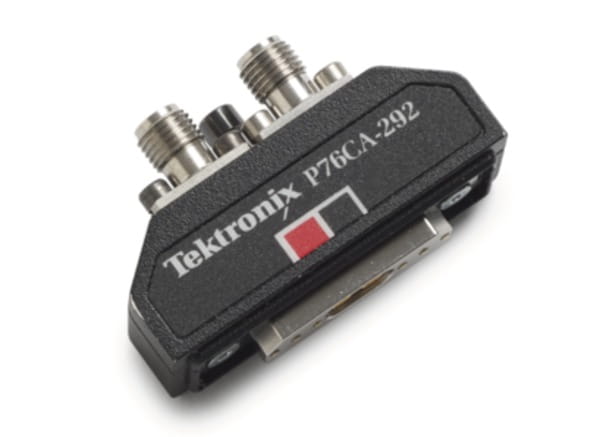
33 GHz bandwidth coaxial adapter with 2.92 mm (female) connector. This adapter is calibrated at the input connector and is well suited for use with off-the-shelf or custom cables. A low-skew cable pair should be used to maintain full-bandwidth performance.
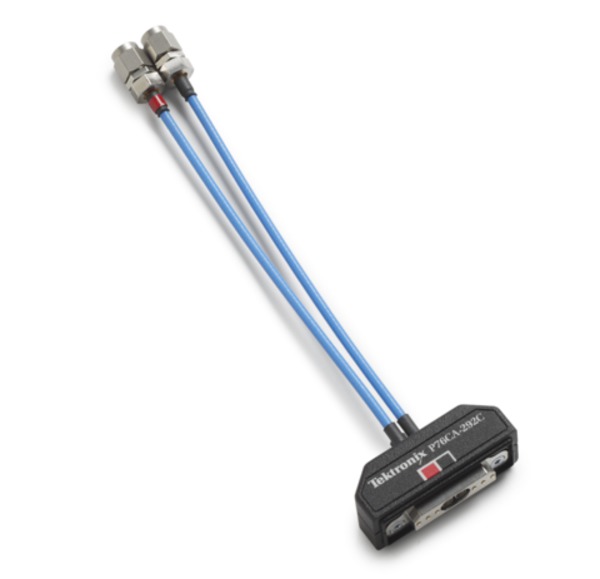
33 GHz bandwidth coaxial adapter with 2.92 mm (pin) connector and 6" high-performance cable. This adapter is calibrated at the input connector and is well suited for connecting devices with 2.92 mm or SMA output connectors.

33 GHz bandwidth coaxial adapter with SMP (socket) connector and 6" high-performance cable. This adapter is calibrated at the input connector and is well suited for connecting devices with SMP output connectors.
This adapter allows the P7630 probe to use existing Tektronix P7500 probe tips. The P7600 Series probe amplifier has a 50 Ω input. When combined with a P7500 probe tip, the probe becomes a passive Z0-type probe with 450 Ω differential input impedance. Z0 probes typically present a large DC load to the device under test, but the P7600 Series probe minimizes the DC loading effect by using termination voltage adjustment.
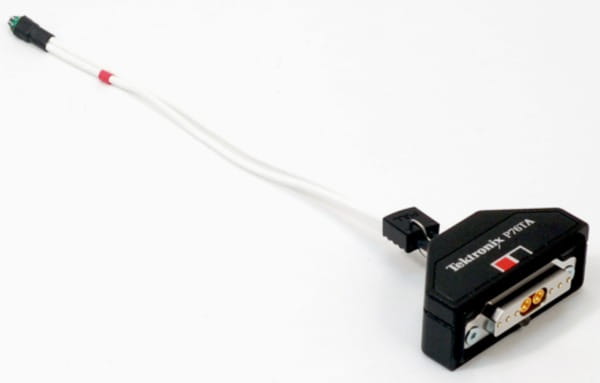
30 GHz bandwidth P7500 tip adapter. When this adapter is used with the P75PST high-performance solder-in tip, the probe and oscilloscope system support bandwidth up to 30 GHz.
P7600 Series probes contain probe-specific S-parameter data. Connecting a P7600 probe to an MSO/DPO70000DX or DPO70000SX oscilloscope transfers this data to the instrument, creating a unique system DSP filter based on the specific S-parameter data of the oscilloscope and probe. As bandwidth increases, creating a unique filter based on the specific system response is critical. At 33 GHz bandwidth, very small changes in the signal path cause large changes in frequency response. These changes are corrected using DSP filtering.
——— Related Applications ———
——— Related Products ———
 PMK FireFly®FF-1500A optically isolated probe 1.3 GHz/1.5 GHz high CMRR (180 dB) high-voltage 2500 V double-pulse VGS gate /VDS drain voltage
 IWATSU multi-channel high-voltage high-frequency optically isolated measurement probe Isolation SE-6000 remote UHV safety test system
 CIC high-voltage differential probe DP20-20K-LVC high-precision 0.1% high-frequency isolated high CMRR 20 kV
| probe Model | P7633 | P7625 | ||
|---|---|---|---|---|
| Adapter | P76CA-xxx | P76TA | P76CA-xxx | P76TA |
| Features | ||||
| Bandwidth | 33 GHz | 30 GHz | 25 GHz | 25 GHz |
| rise time (10-90%) | 14 ps | 16 ps | 18 ps | 18 ps |
| rise time (20-80%) | 11 ps | 12 ps | 14 ps | 14 ps |
attenuation
P76CA-xxx
0.25X / 0.5X / 1X / 2X / 4X
P76TA
1.25X / 2.5X / 5X / 10X / 20X
Input voltage range
P76CA-xxx
1.2 Vpp single-ended, 2.0 Vpp differential
P76TA
6.0 Vpp single-ended, 10.0 Vpp differential
Operating voltage window
P76CA-xxx
-4 V to 4 V
P76TA
-5 V to 5 V
Offset voltage range
-4 V to 4 V
Terminal Voltage Range
-4 V to 4 V
DC input resistance
P76CA-xxx
50 Ω ±2 Ω
P76TA
225 Ω
Input return loss
P76CA-xxx
>20 dB up to 5 GHz
>12 dB, 5 GHz to 20 GHz
>10 dB, 20 GHz to 30 GHz
>8 dB, 30 GHz to 33 GHz
P76TA
Not applicable
Z Minimum
P76CA-xxx
Not applicable
P76TA
225 Ω @ 1 GHz, 150 Ω @ 10 GHz, 100 Ω @ 25 GHz
noise, associated input (oscilloscope set as the system noise at the lowest V/step setting)
rms (33 GHz)
CMRR (Common-Mode Rejection Ratio)
P76CA-xxx
>40 dB, DC
>14 dB, DC to 15 GHz
>6 dB, 15 GHz to 30 GHz
>4 dB, 30 GHz to 33 GHz
P76TA
Not applicable
Lossless input voltage range
P76CA-xxx
-5 V to 5 V (DC peak value AC)
P76TA
-8 V to 8 V (DC peak value AC)
interface
TekConnect
Minimum system requirements
| Instrument | Bandwidth | Firmware Version | Recommended probe |
|---|---|---|---|
| MSO/DPO73304DX, DPO73304SX, and DPO/DSA73304D | 33 GHz | V6.8 and above | P7633 |
| MSO/DPO72504DX, DPO73304SX, and DPO/DSA72504D | 25 GHz | V6.8 and above | P7625 |
Temperature
Work status
0℃ to 40℃ (32℉ to 104℉)
Non-working state
-20℃ to 71℃ (-4℉ to 160℉)
Humidity
Work status
40℃ (104℉) 20%-80% RH
Non-working state
30℃ to 46℃ (86℉ to 115℉) 0-90% RH
Altitude
Work status
3000 meters (9842 feet)
Non-working state
12,000 meters (39,370 feet)

* Specifications are subject to change without notice.

